| Would
your company a major pizza market supplier
like to have an inside track to the buying
minds of the pizza industry? |
Encyclopizza® Menu Home Page/Site Menu Search Website
Encyclopizza®
is researched, written, and complied by John Correll.
Copyright © 2002, Correll Consulting,
LLC. We grant you permission to make a printed copy of any portions of this
website.
All rights reserved. Legal Notice
CONTENTS
The Ready-to-Use Option
Toppings
Popularity
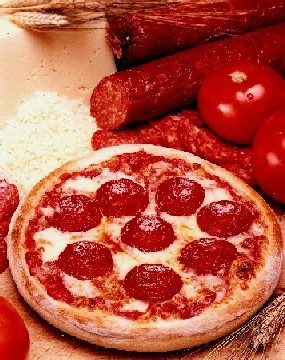
Pepperoni
Composition
Pizza Sausage
Pepperoni-making Process
American-style vs. Traditional
Performance Issues
Coverage and Food Cost
Purchasing
Storage
Slicing Tips
Sample Production Procedure
Set-up
Slicing
Portioning and Storage
Italian
Sausage
Composition
Purchasing
Pre-cooked Sausage
Raw Sausage
Whole Pork Cuts
Making Sausage
Storage
Application
Sample
Production Procedure
Ground Beef
or Hamburger
Purchasing
Making Ground Beef
Storage
Ham &
Canadian Bacon
Types of Ham and Canadian Bacon
Purchasing
Slicing and Storage
Sample Production
Procedure
Set-up
Slicing
Portioning and Storage
Bacon
Chicken
Seafood
Purchasing and
Preparation
Mushrooms
Varieties of Mushrooms
Quality Standard
Mushroom
Growing Process
Fresh Mushrooms
Processing Methods
Size Categories
Whole and Sliced
USDA Grades
Purchasing, Storage, and Preparation
Impact of Storage Temperature
On Vegetables
Canned Mushrooms
Canning Process
Styles (or Cuts)
Grades
Purchasing, Storage, and Preparation
Domestic vs. Imported
Fresh vs. Canned
Fresh-blanched
Mushrooms
Frozen Mushrooms
Onion
Ready-to-use Fresh Onion
Fresh Whole Onion
Early Onions
Late Onions
Purchasing and Storage
To Prepare Sliced and Slivered Onion with a Slicer
To Prepare Diced
Onion Quickly
To Prepare Diced Onion with a Knife
Storage
of Prepared Onion
Pre-cooking
Green
Pepper
Ready-to-use Fresh Green Pepper
Canned Green Pepper
Fresh Whole Green Pepper
To Prepare
Sliced and Slivered Pepper
To Prepare Diced Pepper Quickly
To Prepare Diced Pepper with a Knife
Storage of Prepared Pepper
Pre-cooking
Olives
Quality Standard
Pineapple
Fresh Tomato
To Prepare
Sliced Tomato Quickly
To Prepare Sliced Tomato with a Knife
Storage of Sliced Tomato
Specialty
Toppings
Tips on Preparing Fresh Vegetables
NOTE:
Visit the Encyclopizza
home page for the complete Table of Contents, including pizza dough/crust/sauce
recipes.
THE final part of pizza is the topping. Toppings add special flavor, impart distinctiveness, and build the average ticket price. Although many pizzerias buy ready-to-use toppings, some still prepare toppings on-site. This chapter describes the main kinds of toppings and explains how to purchase and prepare them.
Today virtually every popular topping can be purchased in ready-to-use form—requiring
little or no on-site preparation. So a key question facing pizzeria owners is
whether to buy unprocessed ingredients and prepare them on-site or go with ready-to-use
products. Excellent pizza can be created either way.
The main advantage of ready-to-use toppings is the elimination of problems incurred with on-site preparation. Summarized, this includes doing away with the mess, hassle, and work of preparation. It also reduces the chances for mistakes, production waste from poor preparation methods, product inconsistency and, in the case of meat, removes the inconvenience of handling raw product.
The main drawback of ready-to-use toppings is higher food cost (however, that depends on the amount of waste and trim incurred by on-site preparation). It also takes away the opportunity to advertise custom-prepared products. Whether or not this is an advantage for most pizzerias is debatable. For more discussion on unprocessed vs. ready-to-use toppings, see the On-site Preparation vs. Ready-to-use chapter.
IN CONCLUSION, there is no one right answer regarding ready-to-use versus on-site preparation. An excellent pizza can be made either way. The choice depends on what your customers prefer, as well as the situation and priorities of your business. This chapter describes both options as they apply to various toppings.
Nationally, pepperoni is the most popular topping in the United States. According
to a pizza magazine survey, about eighty five percent of pizzerias rank it #1.
Italian sausage is second and mushrooms are third. Other widely used toppings
include ham, ground beef, chicken, onion, green pepper, bacon, olives, pineapple,
and tomato.
Other toppings found in many pizzerias include such items as shrimp, salami, hot pepper rings, and anchovies. And then there are numerous “exotic” toppings used on specialty pizzas.
Presumably
pepperoni originated in southern Italy (although some say it started in America).
The distinguishing ingredient is cayenne (red) pepper. Since that spice comes
from the peperone plant, as Italians call it, the sausage came to be known as
pepperoni.
Pepperoni, also spelled peperoni, is made with beef and pork. The U.S. Department of Agriculture (USDA) specifies that it must not contain more than 55 percent beef. About a dozen different meat cuts can be used in making the sausage. The exact determination of what cuts to use depends on the manufacturer’s quality and production philosophy.
Percent of fat is typically 40 to 45 percent of total sausage weight. However some companies make products with less fat, sold at a higher price. Generally speaking, the higher the fat content, the cheaper the pepperoni, and vice versa.
Many types of pork and beef cuts can be used in making pepperoni. It’s important that they be fresh and of low pH (i.e., of high acidity). Older meat can result in the fat turning rancid in the pepperoni. Typical cuts might be boneless picnic (pork), lean bull meat, and high-fat belly and navel cuts (both pork and beef). To achieve lowest possible cost some manufacturers vary the types of cuts as market prices fluctuate—a process called “least cost formulation.” Other pepperoni-makers stay with the same formula, believing that it makes for more-consistent quality.
The main seasonings are cayenne pepper, anise, paprika, and salt. Pepper and anise are the distinguishing flavors. Paprika helps mellow out the flavor and also imparts an orange color to the fat, making it less noticeable. Salt—of which pepperoni contains 4 percent—acts as a preservative and flavor enhancer. In addition some pepperoni-makers include black pepper, garlic powder, fennel (an anise-flavored spice), and dextrose (i.e., corn sugar).
For preservation, pepperoni must have high acidity (low pH). To create it, manufacturers add lactic acid bacteria.
To qualify as pepperoni, the USDA standard says it must consist of no more than 1.6 parts moisture to 1.0 part protein, or have a moisture-to-protein ratio of 1.6-to-1.
If the sausage contains higher than 1.6-to-1 moisture-to-protein ratio the product cannot be labeled pepperoni but must be called “cooked sausage for pizza” or “pizza sausage.” Pizza sausage might also be extended with soy protein to reduce its cost. Some manufacturers market pizza sausage under a brand name that resembles “pepperoni” but isn’t spelled exactly the same. This enables them to legally deviate from the USDA pepperoni specification while, at the same time, market a product in competition with real pepperoni. Depending on ingredients, some brands of pizza sausage are not inferior to pepperoni, only slightly different in composition.
From here on we only refer to pepperoni. However, because of the similarity of pepperoni and pizza sausage, most of what we say about pepperoni also applies to pizza sausage.
To understand how brands may vary it helps to know how pepperoni is made. The exact procedure varies between manufacturers, but here’s a typical sequence.
FIRST, large cuts of pork and beef are coarsely ground in a meat grinder, sometimes called a block grinder. The holes in the grinding plate are approximately 3/8-inch diameter. Instead of a grinder some pepperoni-makers use a bowl chopper, also called a silent cutter. It’s a large version of the food cutter or “buffalo chopper” found in many kitchens. With a bowl chopper, a manufacturer can cut the meat into small chunks in one process (thereby avoiding step 3 below). When a grinder is used the product must be passed through a second grinding step. To reduce fat smearing, the product must be maintained at low product temperature—around 30 to 32 degrees F. (Fat smearing can cause pepperoni to grease-out during baking).
SECOND, seasonings, starter culture, and other ingredients are added to the meat and the mixture is stirred in a blender for 2 to 3 minutes. Seasonings might include cayenne (red) pepper, anise, paprika, black pepper, fennel, garlic powder, and smoke flavoring. Starter culture consists of lactic acid bacteria that destroy harmful bacteria and also raise the product’s acidity. The result is improved product flavor and extended shelf life. Other ingredients include salt, sugar, citric acid, and possibly water. A high salt level—approximately 4 percent—helps preserve the product. To promote acid development, a monosaccharide sugar (i.e., glucose or dextrose) is included.
To reduce fat smearing, the product must be kept cold and mixing kept to a minimum.
THIRD, the meat mixture is ground to smaller size in a second grinder (or by continuing to chop it in the silent cutter). Typically the grinding plate hole is either 5/32-inch or 3/16-inch diameter. Pepperoni for pizza is usually made with a smaller hole; deli-style pepperoni may use a larger size. A kick-out blade on the grinder pushes out large pieces of sinew that don’t fit through the holes. Some pepperoni-makers discard this sinew, others, in an effort to lower cost, chop it fine and put it back into the mixture.
FOURTH, the mixture is extruded into a casing. This is known as the stuffing operation. It’s done at about 30 to 32 degrees F. Too high a temperature can cause fat smearing. Too low of a temperature can result in excessive condensation on the product surface. This, in turn, can mandate extended drying time and higher product cost.
Casings come in various types and sizes. The original casing, known as natural casing, is animal intestine—i.e., hog and sheep gut. Most casings used today are artificial and they come in both non-edible and edible versions. Non-edible must be removed before slicing the product—it’s the most common type. Edible casing is left on the sausage. During baking it resembles the performance of natural casing in that it shrinks slightly, causing the pepperoni slice to cup—a feature that some pizzeria owners hate and others love.
After stuffing, the sausage links are hung on mobile racks.
FIFTH, the racks of sausage are put into a pre-drying room, also known as a green room, curing room, incubator, or smoke house. This stage and the drying stage (step 7) are the trickiest part of pepperoni-making and where most problems occur. In pre-drying, the temperature starts at about 80 degrees F and is gradually raised to 128 degrees F over a 22 hour period. During this time the lactic acid bacteria (i.e., starter culture) destroy harmful bacteria and also increase the product’s acidity. Because this process is vital to product safety it’s carefully monitored by electronic equipment and government inspectors. Also, if the temperature is raised too rapidly the meat might not bind properly, which can result in poor slicing quality and grease-out during baking.
During the last two hours of incubation the sausage is smoked. Some manufacturers use “liquid smoke” applied with an atomizer, which fills the room with a mist. Other pepperoni-makers use real smoke created by burning hard wood chips. They believe that real smoke produces a less bitter flavor than liquid smoke.
SIXTH, the sausage is sprayed with water to cool it to 100 degrees F and then it’s moved to a stabilizing room for 2 to 3 hours where the product gradually cools to room temperature.
SEVENTH, the sausage is put into a drying room for 14 to 17 days. Moisture in the sausage slowly evaporates until the product’s moisture-to-protein ratio is 1.6-to-1—at which time the product qualifies to be called pepperoni. (In making pizza sausage this step is either omitted or reduced in length.)
In the drying room the sausage becomes dryer, firmer, narrower in diameter, darker colored, and more strongly flavored. Maintaining optimum drying room conditions is vital to pepperoni quality. The temperature (about 55 degrees F), humidity, and air flow must be precisely maintained to achieve the proper rate of drying. Basically, moisture must evaporate from the surface of the product at the same rate that it migrates from the center of the product to the surface. To achieve this, sophisticated control systems are used. If the product dries too fast, “case hardening” occurs, which seals the surface and prevents interior drying—possibly resulting in spoilage. If drying occurs too slowly it can result in excessive surface mold.
Traditional or deli-style pepperoni is usually dried for a longer period than American-style (see next section for explanation), so traditional pepperoni is harder, darker, and stronger-flavored.
FINALLY, product to be sold in sliced form goes to the slicing room. If it was made from non-edible casing, the casing is stripped off and the sticks are put through an automatic slicer. Small volume operations might use gravity feed slicers, like those employed in commercial kitchens. High-volume manufacturers use large force-feed slicers, such as the Anco bacon slicer. Generally, a force-feed slicer produces pieces of more uniform thickness. During slicing, the product is inspected for blood clots and blue ink. Lastly, it’s packed into poly bags for shipping.
In conclusion, the characteristics of a pepperoni brand are derived from: (1) the type of meat and meat cuts used; (2) proportions of various types of meats used; (3) ratio of fat to lean meat; (4) how its ground—coarse or fine; (5) type and amount of seasonings; (6) type and amount of curing and drying; and (7) type of casing.
There are two basic styles of pepperoni: American-style, which is sometimes called high-performance or no-char pepperoni, and Traditional, sometimes called deli-style and old world style. (These are our terms, and not necessarily used by everyone.) American-style is made with non-edible artificial casing, which produces straight, uniformly thick sticks that are easy to slice. The casing is removed before slicing. The product has an orange-ish rather than reddish color and is milder flavored than traditional style. By comparison to traditional pepperoni, American-style is mild-to-medium spicy. The typical American palate often finds traditional pepperoni to be too hot.
Traditional pepperoni in its original form is made with natural casing, usually sheep gut. The product is a dark red, mahogany color and very spicy. Because of the natural casing it tends to be curvy and vary in thickness, making it difficult to slice. For that reason traditional (natural casing) pepperoni is seldom seen today.
To overcome the problems of natural casing, some pepperoni-makers produce a modified traditional-style pepperoni with edible artificial casing made of collagen. The product is similar in color, diameter, and baking performance to that made with natural casing, except the sticks are straight rather than curvy, making it easier to slice. It’s also less spicy. Pizzerias that use this product purchase it specifically because it cups and chars during baking.
Starting several decades ago many pizzerias showed great concern over how pepperoni baked up. The owners highlighted three objections: cupping, burning, and greasing out—all three of which they felt detracted from the appeal of their pizza. Cupping, as the name implies, is when a pepperoni piece curls into a bowl or cup shape. In doing that it leads to the second objection—burning or charring around the edge. Lastly, the melting fat (which all pepperoni has) collects in the bowl. These conditions are associated with low-moisture, narrow diameter traditional-style pepperoni.
To woo buyers, the manufacturers began engineering pepperoni with minimal cupping and charring. So American-style (a.k.a. high-performance or no-char) pepperoni was born. Presumably it made everyone happy. However, in the rush to overcome “malfunctioning” pepperoni no one stopped to ask, “What do pepperoni pizza-eaters prefer?” Interestingly, when asked, most of them like the pungent, bacony flavor of—yes, you guessed it—curled, crispy, charred pepperoni. Limpid pieces of American-style pepperoni that lie flat on the pizza like steamed salami leave them cold. So which is best—the curly, crispy traditional-style pepperoni, or the flat-baking, non-charring modern version? As with every product decision it depends on the pizzeria—what the owner and customers prefer most. In arriving at this decision we suggest that you leave preconceptions behind and examine the candid preferences of pepperoni pizza eaters.
One of the issues in pepperoni selection is coverage—that is, which brand covers the pizza using the least amount of pepperoni. When comparing American-style to traditional, American-style covers better because it cups and curls less (the more cupping, the more pepperoni pieces are needed to cover the pizza). So to achieve the same amount of coverage, approximately 20 to 30 percent more traditional-style pepperoni is needed than American-style. This could amount to an extra 1/2 to 1 ounce of product which, at a cost of, say 12 cents per ounce, could raise food cost by 6 to 12 cents. Is this enough to warrant not using it? The answer is best determined by asking “What would my pepperoni pizza customers prefer most? Would they opt to pay 6 to 12 cents more for a pizza with curly, crispy, bacony-flavored pepperoni rather than with flat, limpid pepperoni?” If so, charge an extra dime for your pizza and use traditional-style pepperoni … and make customers happier.
Pepperoni can be purchased in diced, sliced, and stick form. Diced pepperoni is a 1/4 inch cube. Sliced and stick pepperoni come in basically two diameters: pizza-size and sandwich-size. The sandwich-size runs 2-1/2 to 2-3/4 inches in diameter. Pizza-size comes in 1-3/8, 1-1/2, 1-5/8, and 1-3/4 inches (or approximately 35, 38, 41, and 44 millimeters). Traditional or deli-style pepperoni is about 1-3/8 inch diameter. The more common American-style is about 1-5/8 inch.
Typical stick lengths include 12, 23, 28, and 48 inches. However, about 90 percent of pizzerias purchase it pre-sliced. The “ounce count” varies with the type of pepperoni. For American-style the most common count is 15 to 16 slices per ounce. However some pizza companies use a thicker slice to improve product appeal and, hopefully, gain promotional advantage. Traditional-style pepperoni is usually sliced thicker than American-style but, because of its smaller diameter, has 17 to 18 pieces per ounce. For large orders most companies will do custom slicing. Slices come air-packed in poly bags, both frozen and unfrozen. Bag weights are 5, 10, 15, 20, and 25 lb., with the most typical being the 25-pound size.
Stick pepperoni can be held refrigerated (33 to 36 degrees F) for two months or more (but it varies with the brand). If frozen below 0 degrees F it has a six month shelf life. When sliced it has a two week refrigerated shelf life at 33 to 36 degrees F. In a gas-flushed bag, sliced pepperoni will keep refrigerated for 30 to 45 days.
RANCIDITY. A problem in storing pepperoni is rancidity. The fat will sometimes turn rancid before the pepperoni spoils. So it’s not uncommon for a pizzeria to unknowingly serve rancid pepperoni. Although it won’t make a person ill, rancid pepperoni imparts an objectionable “fish oil” flavor and odor to pizza. Sometimes a pizzeria owner detects it but doesn’t know what’s causing it. When receiving pepperoni, check the date on the package to make sure it’s not too old. If you don’t know how to read the date code, ask your supplier to explain. In addition, order only what will be used within a week. If you receive rancid pepperoni return it to the supplier for fresher product.
Other than manually, there are two basic ways to slice pepperoni: (1) with a vegetable cutter and (2) with a slicer. A vegetable cutting attachment on a mixer saves the cost of buying a slicer. However it tends to produce a ragged, uneven slice because it chops through food rather than slicing through. So for uniform slices we recommend a slicer.
For best results, have the pepperoni as COLD as possible. This means, don’t bring it from the refrigerator and let it sit on a table for an hour before slicing. When it warms up it becomes mushy, which makes slicing difficult. Some people even recommend slicing it slightly frozen. To do that, keep the pepperoni in a freezer, bring it out a short time before slicing to let it temper, and then slice it in a “soft-frozen” state. Or, transfer it from freezer to refrigerator the night before.
Also, keep the slicer SHARP. A dull blade makes a ragged slice. For good slicing the blade may need to be sharpened weekly because pepperoni dulls it quickly. Use a CLEAN slicer. A dirty slicer spreads bacteria over each slice, making it spoil quicker.
Before slicing, remove the casing. To do that, cut off a tip of the stick, slit the casing down the full length of the stick, and then peel off the casing by pulling from the cut end. To load the slicer, cut the sticks in half or thirds and stack them on end in the cylindrical chute or hopper (which comes as a slicer accessory). Pack them snugly so they don’t tip, but loose enough that they’ll slide down the chute during slicing. Place the hopper weight on top of the pepperoni. To achieve uniform thickness, use a uniform weight or pressure when slicing. Heavier pressure makes thicker slices, lighter presser makes thinner. (For a detailed procedure, see the next section.)
To minimize slices sticking together, refrigerate sliced pepperoni right after cutting. Store it in a closed container at 33 to 36 degrees F. Refrigerate pepperoni sticks in a closed box or container.
The following procedure is for a medium-to-high volume pizzeria that slices American-style pepperoni with an automatic slicer. (For details about slicers, see the Slicers section in the Mixers and Food Processing Equipment chapter.) Keep in mind that procedures may vary slightly between brands of slicers.
1. Obtain the daily production figures from the manager.
2. Clear the tables and work area of unneeded items.
3. Gather utensils:
• Slicer parts – catch tray or pan, chute, weight
• Pepperoni tub
• Cutting board (position to right of slicer)
• Sharp cook’s knife (10-inch blade)
• 2 clean dough trays
• Packaging for pepperoni (plastic bags and ties, or pepperoni tubs and lids)
• Pepperoni crates and dollies
4. Assemble slicer:
A) Unplug electric cord.
B) Set thickness dial at 0.
C) Inspect slicer for cleanliness. If it’s not thoroughly clean, clean it following the Slicer Cleaning Procedure. NOTE: To retard spoilage and insure a wholesome product, the slicer must be clean and sanitized before slicing.
D) If not already in place, attach:
• Sharpening stone cover
• Upper blade cover
• Lower blade cover
• Chute.
Tighten down each item securely.
E) Plug in the electric cord.
5. Place a clean dough tray on the cart below the edge of the slicer. Position it so that it extends out from the edge of the slicer. This tray should catch stray pieces of falling pepperoni.
6. Remove a case of pepperoni from the walk-in cooler and place it on the table next to the cutting board.
7. Remove the casings from the pepperoni sticks (unless traditional-style pepperoni is being used, then leave the casing on). To do this, first cut off one tip of the stick. Then, with the cook’s knife, slit the casing lengthwise, taking care not to cut deep into the pepperoni. Then peel back the casing at the cut end and, firmly grasping it, peel it off by pulling toward the other end.
8. Cut the sticks into thirds of equal lengths. (For traditional-style pepperoni, cut the sticks in half.)
1. Set the slicer to automatic mode, if it’s not already.
2. Set the thickness dial to ____ .
3. Put the catch tray (or pan) on the slicer platform.
4. Move the chute close to you by flicking the slicer on-and-off.
5. Fill the chute with one layer of pepperoni sticks (about 10 lb). Pack it snugly so the sticks won’t tilt, but not so tight that they won’t slide down during slicing. Properly packed, the chute should hold ____ sticks.
6. Put the chute weight on top of the sticks.
7. On slow speed, slice the pepperoni for one minute.
8. After a minute, turn off the slicer. Gather 32 random slices of pepperoni and weigh them. They should weigh 2-1/4 oz. If they don’t, adjust the thickness dial so that 32 slices weigh exactly 2-1/4 oz. (NOTE: The weight of 32 slices will vary depending on the type or diameter of pepperoni.)
9. Slice the remainder of the pepperoni until 1-inch sticks remain in the chute. Then add a new batch of pepperoni sticks on top of the short sticks and continue slicing.
10. When the catch tray is filled, turn off the slicer, empty the contents into a clean dough tray, and slide it to the portioning station. Then resume slicing. Portioning can be done during slicing.
11. After slicing all pepperoni, gather up any irregular pieces from the slicer and trim them into usable pieces with a knife. Mix them into the regular pepperoni.
12. Repeat the above Slicing process for additional pepperoni.
This step is written for packing in plastic bags for shipment to other locations. For strictly on-site preparation, substitute food containers for plastic bags and crates.
Portioning can be done during slicing.
1. Place a plastic bag into a pepperoni tub.
2. Place the tub with bag on the electronic scale.
3. With a scoop, weigh 5 lb pepperoni into the tub. Together, the pepperoni, bag, and tub should weigh exactly _____ lb. (Or, if there’s a tare button, zero-out the scale with the tub on it and weigh out 5 lb of pepperoni.)
4. Seal the bag tightly with a twist tie.
5. Pack 4 bags per crate.
6. Date the crate.
7. Carry the crate to the walk-in refrigerator and stack it on a dolly. Always place the newly sliced pepperoni behind or underneath the older pepperoni. To prevent pepperoni pieces from sticking together, take it to the walk-in as soon as possible.
NOTE: Some pepperoni might need to be frozen. If so, the manager will tell you how much.
8. When finished, clean up following the procedures in the Clean-up section of this manual.
9. Dispose of corrugated boxes by cutting the corners and stacking them flat, thus conserving space in the dumpster.
INTERIM CLEANING: If you will be using the slicer next for ham, onions or green peppers, use this short cleaning procedure instead of the full Slicer Cleaning Procedure. (For full procedure, see the Slicers section in the Mixers and Food Processing Equipment chapter.)
A) Unplug the electric cord.
B) Set thickness dial to 0.
C) With a folded-up, CLEAN, damp cloth, wipe off all loose food from the blade, blade covers, and platform. Be careful around the blade. Also, rinse off the food catch tray.
As
defined by the U.S. Department of Agriculture (USDA), Italian sausage is ground
pork containing salt, pepper, and fennel (or else anise).
Italian sausage, sometimes called “fresh sausage” on pizza menus, must contain—according to the USDA—at least 65 percent pork meat, or no more than 35 percent fat. However, some sausage experts maintain that for a good product the fat content should not exceed 20 percent (or have at least 80 percent lean pork). Pizzeria owners who are interested in knowing the amount of fat in their meat products can find out by using a fat tester. Several companies sell it—one being Hobart.
The maximum allowed amount of excess water (added during mixing) is 3 percent.
The basic seasonings are salt, black pepper, and fennel seed (or anise). However, other ingredients can be included. Cayenne pepper is often added for extra spiciness. Paprika is added to give a fiery color. And some sausage-makers add a touch of garlic or oregano for variety. Although not common, adding sugar or corn syrup gives a little sweetness and also helps the sausage brown during baking.
Most Italian sausage is straight pork but some is a blend of pork plus textured vegetable protein (TVP), also called textured soy protein. It results in lower cost and less fat and cholesterol. Sausage purists avoid “fillers,” but other people say TVP sausage, sometimes called extended sausage, has the same flavor, plus it’s healthier.
There are three purchasing options: (1) buy pre-cooked sausage links, chunks or slices; (2) buy raw prepared sausage (refrigerated or frozen); and (3) buy whole meat cuts and grind them into sausage in your pizzeria.
Option number one is the most popular—with over 50 percent of pizzerias using pre-cooked pork and beef topping (according to a pizza magazine survey). Pre-cooked product can be purchased from a number of suppliers, and comes in many forms, flavorings, and sizes. Regular and low-fat options are available. Mild, regular and hot seasonings are an option. There are also specialty formulas, such as sausage that contains wine. Chunk sizes range from 10 to 45 nuggets or chunks per ounce. It also can be purchased in “scraggly form,” which are irregular-shaped pieces that look like hand-prepared product. Finally, there are both all-meat options as well as extended TVP sausage.
Pre-cooked sausage can also be purchased in links and round slices.
Sausage brands can vary in cooking method—i.e., grilling, roasting, or steaming. Compare several brands before deciding which is best for you. A baking test could prove worthwhile. (See the Baking Test section of the Dough-making chapter for details.)
Raw prepared sausage comes both refrigerated and frozen, and in bulk, patty, link, and rope forms. Link and rope sausage comes in both natural casing (i.e., hog intestine) and artificial casing. Bulk sausage is the most popular form with pizzerias, but link sausage that’s pre-cooked (i.e., boiled) and then sliced in half lengthwise or sliced widthwise (like pepperoni but thicker) can make an attractive topping. Many of the same companies that sell pre-cooked sausage also sell frozen vacuum-packed raw sausage. Due to its longer shelf life, the trend is toward frozen sausage.
In purchasing raw sausage you can specify the percent of fat. The less fat, the higher the price. Thirty five percent is the maximum allowable amount, and would be considered heavy fat. Twenty five to thirty percent would be a moderate amount. And twenty percent or less would be light fat, or lean, as sausage goes. For comparative purposes, most fast-food hamburger patties contain 20 to 24 percent fat.
When fresh, sausage has a pink-red color and the meat pieces appear coarse and distinct. As it gets older the color changes from pink to gray and the meat pieces seem to meld with the fat, to form what appears to be one large, sticky fat-ball.
For grinding your own sausage, one of the more popular cuts is Boston butt (which, contrary to how it sounds, comes from the shoulder of the hog, not the rear end). Another popular cut for sausage is the picnic, which is the top part of the front leg. To reduce costs some sausage-makers use trimmings instead of whole cuts—a practice we don’t recommend.
Inspect the cuts before using them. If there’s too much tendon or fat, bring in the meat salesperson, show him or her the meat, and ask if that’s the proper amount of tendon or fat. If it’s too much, ask them to deliver better cuts next time. However, be forewarned that leaner cuts often cost a little more (but they may not if the meat supplier was selling you an inferior grade at the better-grade price).
Few pizzerias grind their own sausage. However, it’s not hard to do. It can be done with either a meat grinder or a cutter-mixer. (This section explains how to do it with a meat grinder. Directions for using a cutter-mixer are at the end of this chapter.) Here’s the meat-grinder procedure.
1. For good sausage, use quality boneless Boston butts or picnics.
2. Trim off the sinewy tendon and gristle. Cut the meat into small enough pieces to fit into the meat grinder attachment on a mixer. Refrigerate the meat to 35 degrees F, and also keep it as cold as possible during grinding.
3. Prepare the spice blend (see seasoning recipe below).
4. Weigh out the desired amount of cold meat. Put it through the grinder, using a plate with 3/4-inch to 1-inch holes. (If you don’t have such a plate, cut the meat into 3/4-inch to 1-inch cubes.)
5. Sprinkle on the seasoning and blend it uniformly with the meat. Blending small batches can be done by hand, but for large amounts a blending machine is helpful.
6. Put the meat through the grinder again, this time using a plate with smaller holes (i.e., 3/16-inch or 1/4-inch diameter).
Here’s a seasoning recipe for 15 lb of trimmed meat. It’s medium-spicy—adjust it to your taste.
Basic Seasoning for 15 lb Italian Sausage
1-1/2 oz Salt
1-1/2 oz Black pepper
1-1/2 oz Fennel seed (try 1 oz ground and 1/2 oz whole seed)
For spicier sausage any of those amounts can be increased as much as 50 percent. You might also try a little cayenne pepper, garlic, and/or paprika. Other things to experiment with are powdered basil, sage, coriander, and mustard powder. Or, try adding 8 to 12 oz of red or white wine before mixing in the spices. Blend the spices together before adding them to the meat.
Refrigerated shelf life for opened, raw sausage is usually 4 to 5 days but, to be on the safe side, try to use it within 3 days. When vacuum-packed it will last up to 21 days in refrigeration and 4 to 5 days after opening. Refrigerator temperature should be 33 to 36 degrees F.
Shelf life for frozen pre-cooked product is about six months when kept frozen at 0 degrees F or below. Once defrosted it has a 7 to 10 day refrigerated shelf life.
Always follow the manufacturer’s directions with pre-cooked product. And never use any meat product you have doubts about. Spoiled meat often has a slimy surface, unusual color, and/or off-odor.
The easiest sausage to apply is pre-cooked sausage. For the moistest product on the baked pizza, manufacturers suggest applying it in the frozen state. Pre-cooked sausage is well-suited for quick-baked pizza, especially that made with parbaked crust and baked less than 5 minutes.
Pre-cooked sausage also can be prepared in the pizzeria. When using bulk sausage, grill it in a frying pan, or spread the sausage into a 1/2-inch layer on a baking sheet and cook it in the oven for about 10 minutes, or until done. Links can be grilled, roasted, boiled, or steamed. An advantage to pre-cooking is that it produces a less fatty product. It’s also easier to apply than raw product. A drawback is that it raises the cost per serving (because you’re losing some of the fat).
Sausage can also be applied raw. For thorough cooking keep the chunks small. It helps to flatten each piece between thumb and forefinger as it’s laid on the pizza.
Because it’s sticky, applying raw sausage is the slowest and messiest of topping operations. To make it easier some people roll a ball of sausage in cheese, but that’s a bit costly, given the high price of cheese. The best technique is to develop a “sausage flick.” Holding a ball of sausage in one hand, squeeze out a piece between thumb and forefinger. Pick off the piece with the other hand and “flick” it onto the pizza. Good aim speeds pizza-making.
Some people say the easiest way to remove sausage fat from the hands is to dip them in cold water, then wipe with a towel. Lacking time, many pizza-makers go directly for the apron, which quickly results in a messy apron.
This is a procedure for making sausage using a 45-qt cutter-mixer. (For details about cutter-mixers, see the Cutter-mixers section of the Mixers and Food Processing Equipment chapter. Keep in mind that times and procedures vary between brands of cutter-mixers. This procedure happens to be written for a Stephan, Westglen, or Berkel model.)
By substituting beef cuts (round or chuck) for pork cuts, the same procedure can be used for making ground beef.
1. Inspect the pork cuts and, with a sharp boning knife, cut out any bone and large sinewy tendons and gristle.
2. For best grinding, the meat should be partially frozen (28 degrees F).
3. Prior to freezing the meat, cut it into pieces about 1-1/2 inches thick and 1 to 2 lb in weight. Put the meat into a dough tray. Cover it with another dough tray and put it into the freezer.
4. For grinding, remove the necessary amount of meat from the freezer 2 to 3 hours before using. (Another way is to transfer the meat from the freezer to refrigerator the night before.)
5. Assemble the cutter-mixer. Put on the cutting shaft, mixing baffle, and inspection cover. Screw down the locking nut snugly, but not overly tight.
6. Place 15 lb of tempered (partially frozen) meat into the cutter-mixer.
7. Prepare the cutter-mixer for chopping. Close the lid and lock the bowl latch. Tighten the locking handle and insert the locking pin.
8. Grasp the mixing baffle handle with your right hand. With your left hand, turn on the cutter-mixer to low speed by pushing the handle ONE notch away from you (or by pressing the start button). At exactly the same time you start the machine, forcefully turn the mixing baffle CLOCKWISE. Grind the meat for 5 seconds, then turn off the machine.
9. Unlock the bowl latch and open the lid. Sprinkle a measured portion of the spice blend in a circle over the meat. It should be evenly dispersed over the meat, and not poured in one spot or poured next to the shaft.
10. Close the lid and lock the bowl latch.
11. Following the starting procedure described in step 8, turn on the machine and grind the meat for 35 seconds. (The exact time may vary depending on the type of meat, amount of fat, and type of cutter-mixer.)
12. After chopping, turn the mixing baffle handle to the 9 o’clock position, and open the lid. Unscrew the locking nut and remove the cutting shaft. Be careful with the sharp blades.
13. Remove the meat and refrigerate immediately.
Ground beef, or hamburger, comes from grinding the trimmings obtained from cut
up (i.e., boned out) beef carcass. It can also be made from grinding up primal
cuts, such as chuck or round, in which case it’s usually sold as ground chuck
or ground round. The maximum allowable amount of fat is 30 percent. However, many
people believe that for a good product the fat content should be around 20 percent.
Ground beef can be purchased and prepared in the same form as Italian sausage. A pizzeria can (1) buy pre-cooked beef chunks, (2) buy raw prepared ground beef (refrigerated or frozen), and (3) buy whole meat cuts and grind them into ground beef in the pizzeria. For details, see the purchasing section for Italian Sausage.
In purchasing raw beef you can specify the percent of fat. The less fat, the higher the price. For comparative purposes it might help to know that regular hamburgers in most fast-food chains run 20 to 24 percent fat.
Using the same procedure as described for making Italian sausage, you can grind ground beef on-site—either in a meat grinder or in a cutter-mixer. Refer to that section for details.
Most ground beef for pizza is seasoned with salt and black pepper. However, for something a little zingier here’s a spice formula for 15 lb of ground beef.
Basic Seasoning for 15 lb Ground Beef
1-1/2 oz Salt
1-1/2 oz Black pepper
3/4 oz Granulated garlic
1/2 oz Mustard powder
1/4 oz Celery seed
For spicier beef any of these amounts can be increased as much as 50 percent. For more variety, try adding a dash of cayenne pepper, oregano, cumin, or nutmeg.
In storing beef use the same guidelines as for Italian sausage. See that section for details.
The third most popular meat on pizza, behind pepperoni and Italian sausage, is
ham and Canadian bacon.
Ham comes two basic ways: fresh and processed. Fresh ham has had nothing done to it. Processed ham is cured, smoked, and/or cooked.
Correctly speaking, ham is that cut of pork—processed or fresh—which comes from the hind leg or thigh of the hog. However, other cuts, such as the picnic which comes from the shoulder area, are often referred to as ham (e.g., picnic ham) after being processed.
Canadian bacon comes from the tenderloin, or back muscle, of the hog. It’s sugar-cured, smoked, and cooked. Canadian-style bacon comes from the rear sirloin muscle and is formed to look like Canadian bacon. For pizza topping purposes there’s probably little point in differentiating. Canadian and Canadian-style bacon comes diced, sliced, and in whole sticks with a range of diameters. Canadian bacon, because of its low fat content and long curing time, is usually more expensive than regular ham.
Unlike Canadian bacon, regular bacon comes from the side or lower flank section of the hog and, as a result, is much fattier than Canadian bacon.
Ham comes whole (uncanned), canned, and ready-to-use in poly bags. Most pizzerias purchase either canned or pre-sliced ham.
Ready-to-use ham is the most popular form. It’s packed in a poly bag and comes crumbled, sliced, diced, and in julienne strips (long, thin, rectangular pieces). Refrigerated and frozen is available.
Canned ham comes in numerous sizes and shapes, including pear-shaped, square, and rectangular or pullman. Pullman is probably easiest to slice. There are so many kinds and brands of ham it’s impossible to categorize them. The key to purchasing canned ham is to buy several kinds and compare them on quality and cost per pound. Evaluate ham quality on such factors as:
• Flavor
• Color
• Amount of fat
• Amount of juice and gelatin (i.e., wasted fluid)
• Degree of shrinkage in baking
• Ease of processing (slicing, dicing).
When computing cost per pound, base the figures on the weight of finished product (yield after trimming and slicing) rather than on purchased weight. Some canned hams have considerable fat and gelatin. Also, some have very high water content, which results in excessive shrinkage during baking. Generally speaking, the lower the price, the higher the fat, gelatin, and water content.
When slicing it on-site, use a CLEAN, sanitized slicer. A dirty slicer spreads bacteria over each slice, making it spoil quicker. Keep ham refrigerated in a closed container at 33 to 36 degrees F.
This procedure is for slicing ham using an automatic slicer.
CANADIAN BACON. For slicing Canadian bacon or any other cylinder-shaped piece, remove the casing, cut the stick lengthwise into four parts, then slice as you would for pepperoni (see Pepperoni section).
CANNED HAM. Here’s a procedure for slicing canned ham into julienne strips about 1/8-inch thick and 1-inch long. Keep in mind that procedures may vary slightly between brands of slicers, types of ham, and type of cut. This procedure happens to be written for a medium-to-high volume pizzeria that slices a pullman-style canned ham with an automatic slicer. (For details about slicers, see the Slicers section in the Mixers and Food Processing Equipment chapter.)
1. Obtain the daily production figures from the manager.
2. Clear the tables and work area of unneeded items.
3. Gather utensils:
• Slicer parts – catch tray or pan, chute, weight
• Ham tub
• Cutting board (position to right of slicer)
• Sharp cook’s knife (10-inch blade)
• 2 clean dough trays
• Packaging for ham (plastic bags and ties, or ham tubs and lids)
• Ham crates and dollies
4. Assemble slicer:
A) Unplug electric cord.
B) Set thickness dial at 0.
C) Inspect slicer for cleanliness. If it’s not thoroughly clean, clean it following the Slicer Cleaning Procedure. NOTE: To retard spoilage and insure a wholesome product, the slicer must be clean and sanitized before slicing.
D) If not already in place, attach:
• Sharpening stone cover
• Upper blade cover
• Lower blade cover
• Chute.
Tighten down each item securely.
E) Plug in the electric cord.
5. Remove a case of hams from the walk-in cooler and place it on the table next to the cutting board.
6. Take two hams from the case and set them in a clean dough tray. Remove the wrapping by slitting it lengthwise with the knife and pulling it off.
1. Set the slicer to automatic mode, if it’s not already.
2. Set the thickness dial to ____ . (It should produce 1/8-inch thick slices.)
3. Place the catch tray or pan onto the slicer platform.
4. Move the chute close to you by flicking the slicer on-and-off.
5. Place a ham into the chute and put the weight on top.
6. Slice the ham until a 1-inch piece remains in the chute. Then turn off the slicer, add the second ham, put on the weight and continue slicing.
7. During slicing, stack the pieces into neat stacks about 4-inches high.
8. Place the stacks on the cutting board.
9. With the cook’s knife, cut each stack into fourths lengthwise; thereby producing four stacks of ham strips about 1 to 1-1/2 inches wide.
10. Fill the chute with the stacks of ham strips. Put them in ON END. Pack them snugly so they won’t slide sideways. The chute will hold two layers of strips.
11. Put the weight on top.
12. Set the thickness dial to ____ . (It should produce 1/8-inch thick julienne strips.)
13. Turn on the slicer. You should get small julienne strips about 1/8-inch thick by 1 inch long. Occasionally a slice will slide out without getting sliced. Gather up the unsliced pieces and cut them into usable-sized pieces with the cook’s knife. No ham should be discarded (except, of course, that which falls on the floor).
14. When the catch tray is filled, turn off the slicer, empty the contents into a clean dough tray, and slide it to the portioning station.
15. Repeat the above Slicing process for additional ham.
This step is written for packing in plastic bags for shipment to other locations. For strictly on-site preparation, substitute food containers for plastic bags and crates.
Portioning can be done during slicing.
1. Place a plastic bag into a ham tub.
2. Place the tub with bag onto the electronic scale.
3. With a scoop, weigh 5 lb ham into the tub. Together, the ham, bag, and tub should weigh exactly _____ lb. (Or, if there’s a tare button, zero-out the scale with the tub on it and weigh out 5 lb of ham.)
4. Seal the bag tightly with a twist tie.
5. Pack 4 bags per crate.
6. Date the crate.
7. Carry the crate to the walk-in refrigerator and stack it on a dolly. Always place the newly sliced ham behind or underneath the older ham.
NOTE: Some ham might need to be frozen. If so, the manager will tell you how much.
8. When finished, clean up following the procedures in the Clean-up section of this manual.
9. Dispose of corrugated boxes by cutting the corners and stacking them flat; thereby conserving space in the dumpster.
INTERIM CLEANING: If you will be using the slicer next for onions or green peppers, use this short cleaning procedure instead of the full Slicer Cleaning Procedure. (For full procedure, see the Slicers section in the Mixers and Food Processing Equipment chapter.)
A) Unplug the electric cord.
B) Set thickness dial to 0.
C) With a folded-up, CLEAN, damp cloth, wipe off all loose food and juice from the blade, blade covers, and platform. Be careful around the blade. Also, rinse off the food catch tray.
Bacon is a popular
tasty topping with many meat lovers. It can be applied in raw and in pre-cooked
form. When used raw it should be put on top of the other toppings to insure thorough
cooking. Due to its high fat content, bacon tends to add greasiness to pizza.
For this reason—and because it’s highly flavored—most operators use it sparingly.
Pre-cooked bacon is easier to apply and less fatty than raw product but, of course,
higher priced. Nonetheless most pizzerias prefer it. Whether raw or pre-cooked,
for best results use a top quality, low fat product.
In the past
decade chicken has gained acceptance as a pizza topping. It typically comes pre-cooked
and pre-seasoned. Popular seasonings or “flavors” for pizza topping usage include
Italian, fajita, mesquite, and barbecue. It comes in a variety of forms including
diced (1/4-inch to 3/4-inch), strips, shredded, and julienne sliced (about 3/8-inch
wide).
As with any meat product, keep it refrigerated in a closed container at 33 to 36 degrees F.
The traditional
“pizzeria seafood” is anchovies. Everyone believes they go on pizza but few people
order them. Being a salted, cured product that’s packed in olive oil, they impart
a strong, pervasive flavor. One fillet flavors an entire pizza slice. After cutting
an anchovy pie many pizzerias rinse off the cutter or knife because oil residue
can impart anchovy flavor to the next pizza. Once a can is opened, remove the
anchovies and refrigerate them in a small, closed container.
Recently other seafood has been finding its way onto pizza. The list of potential seafood toppings is seemingly endless. The most commonly mentioned items include crab, shrimp, squid (calamari), scallops, clams, and mussels. In certain European countries, such as Germany, canned tuna is the #1 pizza topping. In Japan, shrimp is very popular. And in Korea dried squid is a hit.
Some pizzerias prefer using imitation seafood items, such as imitation crab legs made from surimi.
Seafood comes fresh, canned, and frozen. Many pizzerias avoid fresh items because of the difficulty in buying, storing, preparing, and applying it.
The advantage of canned products is that they’re easy to store, handle, and spread on the pizza. The potential drawback is that they sometimes dry out during baking. To minimize drying, some pizzerias put a thin layer of cheese over canned seafood items. Others put the seafood underneath moist toppings, such as sliced tomato or other vegetables.
The main advantage of frozen products is that they don’t dry out as much as canned during baking. Some people also believe they’re more flavorful. The potential drawback is that they can cause water build-up on the pie. To prevent this, thaw the product first and drain it well. If puddles of water form, remove them by dabbing with a clean paper towel before cutting the pizza. Store frozen product at 0 degrees F or below. Thaw it in a refrigerator for about 24 hours. Do not thaw seafood at room temperature.
Fresh and frozen seafood has a mild flavor that tends to be overpowered by pizza spice. To enhance its flavor you might consider (1) first sautéing the item in garlic butter or olive oil before assembling the pizza, and/or (2) marinating it in liquid, such as a mixture of olive oil and lemon juice that contains strong spices like a blend of salt, garlic, onion, and cayenne pepper. Such items are often promoted under names like “Cajun shrimp.”
The right size or cut of a seafood item is important. The smaller the cut, the easier it spreads and “covers.” Size also plays a role in moisture balance. Small pieces dry out more, larger pieces less so. If water build-up is a problem, go with smaller pieces. If drying is a problem, use thicker ones.
Another trick to reducing drying is to cook the seafood item separately (i.e., simmer, grill, sauté—whatever fits the item) and then place it on the pizza right after it comes from the oven.
Seafood is also used on “white pizza”—or pizza with cheese only, no tomato sauce. Some pizza-makers note that flavor comes through better without the heavy flavor of spicy pizza sauce.
To cover the higher cost of most seafood items, pizzerias often charge “double topping price” or sell it as a specialty pizza for a little more money.
Mushrooms
are the third most popular topping overall, and the most popular of vegetable
toppings. Pennsylvania is the main domestic (U.S.) producer—providing over 45
percent of mushroom production—followed by California and then Michigan.
Just a few years ago there were over twenty major U.S. mushroom growers. However, since the 1970’s there has been a rise in low-priced imported canned product, especially from mainland China, and the number of large U.S. producers has dropped to less than ten.
A source of information on mushrooms is the Mushroom Council (916-781-7585) and the Mushroom Cooperative Company (610-444-1400)
There are thousands of varieties of edible mushrooms which come in various shapes and colors. However the most common—which comprises 95 percent of commercial production—is a round-capped version that goes by the scientific name Agaricus bisporus. Most pizzerias use this variety, so it’s the only type of mushroom discussed here. Henceforth, when we speak of “mushrooms” this type is what we’re referring to.
Agaricus bisporus comes in four strains, each having a different surface color. The colors are white, off-white, cream, and tan or brown. White mushrooms have a smooth, snow-white cap. Off-white have a slightly scaly, white cap. Cream have a smooth, cream-colored cap. And brown have a smooth, chocolaty-colored cap. White and off-white are popular on the East Cost. Brown mushrooms—sometimes called California Browns—are common on the West Coast. Although surface color varies between strains, there is little difference in taste, texture, and internal color. Nonetheless, white and off-white strains are mainly grown for the fresh market and for canning, while cream and brown types are used in processed foods such as soups and sauces.
Within each of the four strains there are various hybrids which differ in firmness. The firmer (harder) hybrids are produced for the fresh market and the softer kinds are used in canning.
Top quality mushrooms are young, firm, smooth, and unblemished. The veil is unbroken and joining the cap. (The veil is the membrane on the underside of the cap which extends from the cap to the stem.) Stems should be closely trimmed—or no longer than the diameter of the cap.
On a young mushroom the veil extends all the way from the cap to the stem and, so, covers the gills. As a mushroom ages it loses moisture and the cap opens, which separates the veil from the stem. Such a mushroom would be called an “open-veil unit.” Fresh mushrooms with an open veil still have good flavor but should be used soon as they won’t last for long. Interestingly, even though mushrooms with an open veil are considered to be of “lesser quality,” some people prefer them because they have a stronger, more distinct flavor than younger, closed-veil mushrooms. For this reason chefs often prefer older mushrooms for use in soups and sauces.
Other signs of age are: (1) an overall darkening or black color, (2) soft, flabby cap or stem (with a young, fresh mushroom, when the cap is separated from the stem it comes off with a “snap”), and (3) black or dark brown gills (on younger mushrooms the gills will be light pink or tan in the fresh and frozen forms, and light gray or pale yellow in the canned form).
Many misconceptions surround mushrooms. To shed light on the subject (pardon the pun), and provide the pizzeria owner with insight into how this tasty morsel is created, we describe the interesting process of mushroom growing. The specifics vary from grower to grower depending on the production system. However, generally this is what’s involved.
FIRST, compost—the growing medium—is prepared. Typically, compost for mushrooms is a mixture of straw and horse manure. However other ingredients such as hay and crushed corn cobs might be included. To provide additional nitrogen, soy bean and other organic matter is also mixed in. Finally, gypsum is added as a conditioning agent to give a dryer, “less greasy” texture. Some compost is made without horse manure, in which case it’s called synthetic compost.
Typically compost is made by the mushroom producer. It involves turning, watering, and aerating the compost mix. It takes 7 to 14 days to make a batch. Because properly-made compost provides key nutrients for mushroom growth, many growers consider this phase to be the most important step of production. A good batch of compost can produce 3 to 5 crops of mushrooms. When the compost has developed the desired color, texture, chemical composition, and temperature (about 170 degrees F), it’s ready for growing the tasty little ‘shrooms.
SECOND, a growing room is prepared to receive the compost. This is done by sterilizing the room with steam to remove undesirable bacteria and spores. There are two main types of growing systems. In one, called the bed or shelf system, mushrooms are grown on fixed shelves and, so, the entire mushroom growth cycle is done in one room. The shelves are stacked several layers high with about three feet clearance. In another system, called the zoned system, the mushrooms are grown in movable wooden trays, stacked six to eight high, and the trays are moved to different rooms during various phases of the growing process.
THIRD, compost is spread onto the shelves or trays to a depth of about three inches. Then the room is filled with steam and brought up to a temperature of 140 degrees F for two to four hours. This pasteurizes the compost and removes harmful organisms.
FOURTH, the compost is conditioned by maintaining room temperature at 120 to 130 degrees F for about twelve days. During this time ammonia odor dissipates and the compost is re-populated with certain desirable bacteria which create nutrients for mushroom growth. (This is the general procedure for pasteurizing and deodorizing compost—the exact process varies among growers.)
FIFTH, mushroom spawn is sprinkled over the compost and then mixed in with a machine. Typically, spawn consists of rye grain that is covered with mushroom mycelium, or microscopic fungus filaments that eventually grow and produce a mushroom. On the grain the mycelium appears as a thin, white powder. (Making spawn requires a special process and is done by companies known as spawnmakers.)
SIXTH, the compost is covered with a clear plastic sheet for two to three weeks—a period called the spawn run. The plastic keeps out harmful microorganisms and also retains compost moisture. During this time the mycelium grow and join together (called anastomosis), forming a thick, white mycelium network throughout the compost. On top will appear a delicate, white, cobwebby quilt of mycelium.
SEVENTH, metal rings about 12-inches in diameter, called casing rings, are placed on top of the compost. On top of that is added 1 to 2 inches of peat moss, called casing layer. For a period of about ten days, called the case run, the peat moss is watered until it is fully saturated. During this time, the mycelium form into thick white strings called rhizomorphs. They are the precursor to mushroom growth.
EIGHTH, after about ten days the casing layer is “scratched” with a machine that breaks up the rhizomorphs and re-distributes them throughout the peat moss. The room is then sealed off so carbon dioxide content will build up, which aids the start of mushroom growing. In two to four days the rhizomorphs re-join together. During this time, little white knots, called pins, begin to form on the surface of the peat moss. Each pin will become a mushroom.
NINTH, after two to four days the room is flushed with fresh air in order to lower the carbon dioxide level. Within seven to ten days the pins grow into pickable mushrooms, a period called pinning. The elapsed time from start of the casing run to picking is about three weeks.
TENTH, after harvesting a crop of mushrooms (called a flush, break, or bloom) a new crop begins growing in its place. The process of harvesting mushrooms is called cropping. In total, a grower gets 3 to 5 crops per batch of compost, after which the “spent” compost is removed and the entire process is started anew, beginning with sterilization of the room and bringing in new compost.
After picking, mushrooms are prepared and marketed four basic ways: fresh, canned, fresh-blanched, and frozen. We’ll discuss each.
Because of price and ease of application, fresh mushrooms are the most popular type in pizzerias. According to a pizza magazine survey, 79 percent of pizzerias use fresh mushrooms, 18 percent used canned, and 3 percent use both.
A top-quality fresh mushroom for pizza topping should be smooth, firm, and free of major blemishes. The surface should be dry (but not dried) and free of slime or slickness. The veil should be closed, meaning the underside membrane should be attached to both the stem and cap. And, of course, it should be free of dirt or compost.
Quality of fresh mushrooms varies, depending largely on the distributor’s processing methods. For top quality and maximum shelf life a consistent temperature between 33 to 38 degrees F must be maintained throughout the shipping, processing, and storage process. In addition, to provide maximum shelf life for the pizzeria, the product should be shipped within 24 hours after being received by the processing plant. Good processors maintain consistent low temperature and move product quickly through the system. For example, they might receive it in early morning, process it in late morning, and ship it out in the afternoon.
Processing methods vary between distributors. To compare companies, tour the plants and have them show what they do to insure quality. Check out their methods, number of quality inspectors, time from receiving to shipping, etc. A good producer might process mushrooms in the following way.
First, the fresh mushrooms are washed in chlorinated water. The water removes dirt and the chlorine kills harmful organisms. Second, the units are sorted by size. Third, they’re air dried with fans. Fourth, they’re sliced. Fifth, the product is packed in vented corrugated boxes, although plastic pails might be used as well. Sixth, it’s shipped immediately. And throughout the process a consistent, cool temperature is maintained.
The American Mushroom Institute gives three size categories for fresh mushrooms.
SMALL = Under 1-1/8" cap diameter
MEDIUM = 1-1/8" to 1-5/8" cap diameter
LARGE = Over 1-5/8" cap diameter
Small ones often go into salads. Medium is probably the preferred size for pizza topping. However small and large sizes work, too. Mushrooms over 2-1/2 inches are sometimes called “silver dollar” mushrooms and also “stuffing” mushrooms.
Fresh mushrooms can be purchased whole and also sliced. The best for pizza is “sliced whole,” or a lengthwise cut which retains the characteristic mushroom silhouette. Some companies offer a choice of thickness—such as 1/8-inch, 5/32-inch, 3/16-inch, and 1/4-inch thick. Thinner cuts give greater yield but they also tend to shrivel and turn black in the oven. The slice should be thick enough to avoid shrinkage and discoloring during baking.
Some processors offer a choice of grades based on the U.S. Dept. of Agriculture (USDA) grading system.
There are two grades involved with fresh mushrooms: U.S. #1 and U.S. #2. U.S. #1, or prime, consists of young, firm, smooth, unblemished mushrooms with the veil unbroken and joining the cap. They usually have about a 12-day shelf life after picking. U.S. #2 consists of older, darker-colored units with open veils. They have an earthier flavor (which some people prefer). Because of their greater age they have about half the shelf life of U.S. #1 grade.
The preferred packaging for fresh mushrooms is a vented corrugated box. It usually comes in 10 lb size.
For maximum shelf life—which is about seven days in the pizzeria—store mushrooms at 33 to 35 degrees F and 85 to 90 percent humidity. When stored over 40 degrees the shelf life is greatly reduced. Allow for good air circulation. Do not put them in a closed container or non-porous plastic bag. Also, allow 2 inches between boxes and do not stack other boxes on top of them. To prevent excessive drying, which might occur if stored in a place of low humidity, drape a damp cheesecloth over them. Buy only what will be used within seven days. Rotate stock so that the oldest product is used first.
Even though mushrooms are cleaned by the producer, an occasional piece of soil may be found. With whole mushrooms, simply brush off the dirt with a damp towel or soft brush. However, widespread soil throughout a shipment is unacceptable. Such mushrooms should be returned to the supplier for credit. If the problem persists, consider another supplier.
Don’t soak fresh mushrooms in water as it makes them water-logged and speeds deterioration.
Most pizzerias don’t pre-cook mushrooms for pizza topping. However, to increase their flavor, sauté sliced mushrooms in butter or in pomace or pure olive oil for a few minutes until the slices begin to lightly brown. This can be done a day ahead. Keep sautéed mushroom in a refrigerator. (Sautéing is the process of frying food in a pan with a small amount of oil—about 1/16-inch—at a temperature high enough to make the food sizzle. It’s stirred occasionally and, to promote steaming, might be covered with a lid.)
Holding time, or shelf life, of cut fresh vegetables depends upon storage temperature. Using an arbitrary vegetable with a holding time of 14 days at 35 degrees F, the chart below depicts how shelf life is greatly reduced as storage temperature rises. Although cut vegetables vary in maximum holding time, higher storage temperature reduces the holding time for all of them.
Impact
of Temperature on the Holding Time
of a Fresh Vegetable having a 14-day Maximum
Shelf Life
Temp. Holding Time
35° F 14 days
40° 10 days
45° 5 days
50°
2 days
60° 1 day
70° 1/2 day
Clearly, there’s great benefit from storing fresh, cut vegetables between 33 to 35 degrees F.
Not long ago canned mushrooms reigned supreme in pizzerias. Many owners still use them. They come in two colors: white and brown. To lighten the color of certain varieties, canners might bleach them with ascorbic acid. Foreign canners might also use citric acid.
Here’s how canned mushrooms are made.
First, the freshly picked mushrooms roll down a set of vibrating rails, where bits of straw and small mushroom pieces are removed.
Second, they’re sprayed with water and then blown with air to remove any remaining dirt.
Third, they’re sorted by quality. Those with open veils and any defects are separated out. The remaining mushrooms are then classified and usually sold as “Grade A” and “Grade B” by the canner.
Fourth, the mushrooms proceed to a hydrator. Two processes happen there. First they enter a vacuum chamber which pulls all water from the mushroom. Then they’re plunged into a water bath, whereupon they re-absorb even more water than they originally held. This results in a darker colored mushroom and also keeps it from breaking down in the next step—the hot water blanch.
Fifth, mushrooms are blanched in 212 degrees F water for 10 minutes—in essence, cooking them.
Sixth, they’re sorted to separate out any units with open veils.
Seventh, they’re sliced (see next section) and the pieces are then chilled.
Eighth, cans are filled with product, packed with brine (i.e., salt water), and topped in a capper, or closing machine.
Ninth, the cans go to a cooker, or retort, for sterilization. Internal temperature of the can contents is brought up to at least 185 degrees F. Then the cans are cooled, labeled, packed into cases, and palletized for shipment.
For pizza use canned mushrooms come in four styles or cuts. In order of usage, they are as follows:
PIECES AND STEMS, or stems and pieces. This style contains a large percentage of broken portions of the cap and stem. The exact amount varies between products. A good pieces and stems product, which a canner might sell as “Grade A,” would contain almost 50 percent silhouettes. (A silhouette is a mushroom-shaped piece, and it comes from slicing whole mushrooms lengthwise.) A product labeled “Grade B” might contain 30 to 35 percent silhouettes. Also, a Grade B product would be made from lower quality mushrooms—that is, darker mushrooms with open veils. Since the percentage of silhouettes included in pieces and stems can vary between canners, it’s wise to examine the product when comparing brands, even when they carry the same grade.
WHOLE SLICED, or sliced whole. This style contains mostly silhouettes. The percentage could range from 65 to 80 percent, depending on the brand and grade. Typically the product would be sliced about 3/16-inch thick.
PIZZA CUT, or chips. This style is created by slicing mushrooms into a shoestring shape of about 1/8-inch thick and of random length. It’s popular in some areas of the Midwest, such as Indiana and Ohio.
DICED. This consists of 3/8-inch cubes. The pizzeria owners who use it prefer it for portion control reasons.
There are other styles of canned mushrooms but they’re not commonly used for pizza. For example, buttons are small caps with attached stems less than 1/8-inch long. Whole style consists of caps with attached stems that are longer than 1/8-inch. Random sliced whole are whole mushrooms sliced in various random directions. Sliced buttons are buttons that have been sliced horizontally across the cap.
Most canners sell two grades of canned mushroom: A and B. Be aware that a canner’s Grade A is probably not the same as U.S. Grade A (a specification of the U.S. Department of Agriculture). For a canned mushroom to qualify as U.S. Grade A, no more than 5 percent of the pack can have open veils (that is, mushrooms with veils not covering the gills). A canner’s Grade A—not to be confused with U.S. Grade A—usually contains more than 5 percent open-veil product. As such, a canner’s Grade A is roughly the equivalent of U.S. Grade B.
The main criteria used in determining grades is the amount of open veil. Grade A would consist of a greater percentage of young, white, closed-veil units. Grade B would have a higher percentage of older, darker, open-veil units. However, flavorwise, some people consider an older, darker mushroom to be superior. So grades are based largely on appearance, not flavor.
Pizzerias mainly purchase canned mushrooms in No. 10 cans. Typically, the drained weight of a standard No. 10 can—that is, the weight of the product after it has been allowed to drain for two minutes—is 68 ounces (4 lb - 4 oz). However, more recently a No. 10 can with 62 oz drained weight has come on the market. It’s frequently sold on the East coast. When comparing prices be sure to consider drained weight of the products.
As with all canned products, store canned mushrooms in a cool (70 to 80 degrees F) dry place. Shelf life is about 21 months.
Keep the blade on your can opener sharp. Replace it as needed. A dull or notched blade (from opening too many cans) can scrape thin metal shavings into the product.
Because canned mushrooms are packed in water they should be drained for at least an hour before using. Some pizzerias put them into a colander with a dough tray underneath and drain them in a refrigerator overnight.
Once opened, use canned mushrooms within three days. Also, keep them refrigerated. They contain protein, which supports bacterial growth and, so, will spoil at room temperature.
As with fresh mushrooms, canned mushrooms can be sautéed before applying to pizza, although it’s not commonly done.
During the 1970’s imported mushrooms made large inroads into the American market. U.S. producers had difficulty matching the imports’ low price and, as a result, many producers closed. Today about two-thirds of canned mushrooms used in the U.S. are imported. Oddly, the U.S. Dept. of Agriculture requires that domestic product be produced under stricter standards than that which is allowed to be imported. Mainly, the specification for the amount of foreign matter allowed in a can is more stringent for U.S. packed mushrooms than for imported. Imported canners can also use bleaching agents which U.S. companies are forbidden to include. These factors may be something you want to consider when comparing prices and brands.
Sometimes pizzeria owners debate the merits of fresh vs. canned mushrooms. In a nutshell, here’s the pro’s and con’s of each. If purchased in whole form, fresh mushrooms require slicing time. However most pizzerias purchase them pre-sliced. Fresh mushrooms spread easily. They’re usually less expensive than canned. However, they have greater tendency to shrivel up and discolor from baking. To minimize shriveling they must be cut fairly thick. They also tend to darken on a pizza that’s held in a warmer. Finally, they must be used promptly as they have a maximum 7-day shelf life.
Canned mushrooms must be drained well for easy application, which requires time. Although not difficult to spread, they’re just a little tougher to spread than fresh. And they’re usually more expensive than fresh. However, they don’t dry up and discolor as quickly in baking and holding. Also, some people feel the flavor of canned mushrooms comes through better than does that of fresh. Canned product is also available in marinated forms which can provide a unique flavor enhancement. Finally, they don’t require refrigerated storage.
In addition, some people feel there’s a difference between canned and fresh in how they affect the baking of a pizza. To decide between canned and fresh we recommend testing both and then choosing the one that best fits your product and production methods.
Fresh-blanched mushrooms—also known by other names, such as quick-blanched—are a relatively new product that came on the market in the late 1980s. Basically, fresh-blanched mushrooms are processed the same as canned mushrooms, except that instead of packing the product in a can and heating it in a retort, fresh-blanched mushrooms are packed in a paper carton or a plastic pail with brine solution and then refrigerated. Container sizes range from 4 to 20 lb drained weight. Unopened, it has a 90 day shelf life. After opening, it should be used within 14 days. Compared to cans, the main drawback is that it must be stored refrigerated. Some operators also do not like the flavor of fresh-blanched (due to the preservative). Pizzeria owners who use fresh-blanched mushrooms like them because they more closely resemble the appearance of fresh product than canned mushrooms do, while being less perishable than fresh product. In effect, fresh-blanched offers a compromise between fresh and canned.
Mushrooms come individually quick-frozen, or IQF. Such mushrooms are sliced and frozen within 24 hours after picking. They have a one year shelf life. They come whole, whole sliced, and as stems and pieces.
Onion is a traditional
pizza topping. It provides an accent to cured meat, such as pepperoni, ham, and
bacon, and complements mozzarella cheese. In the U.S. the main onion producing
states are New York, Michigan, Utah, Texas, California, Idaho, Oregon, Colorado,
and Washington. Two sources of information on onions are the National Onion
Association (303-353-5895) and Imperial Sweet Onion Commission (619-353-1900).
Onions come canned, dehydrated, frozen, fresh whole, and fresh ready-to-use. Most pizzerias purchase either fresh whole or ready-to-use.
Ready-to-use onion comes slivered, diced, and in rings. Pizzerias mainly use slivered or diced. Slivers are pieces about 3/16-inch thick and 1 to 3 inches long. Diced onion comes in a choice of 1/4-inch and 3/8-inch cubes.
One producer prepares ready-to-use onion by the following process. First, the onion is peeled and cored. Second, it’s cut into quarters. Third, it’s inspected and woody pieces, bruised and decayed units, and remaining skin and core is picked out. Fourth, the quarters are sliced or diced. Fifth, cut product is washed in chlorinated water. Sixth, it’s spin dried. Finally, it’s vacuum packed in 2-, 3-, and 5-lb poly bags and shipped. Special bag material allows oxygen and water vapor build-up in the bag to dissipate, which lengthens product shelf-life.
To compare suppliers of ready-to-use product, tour their plants and have them show what they do to maintain quality. Take note of plant cleanliness, number of inspectors on a production line, storage times, processing methods, and testing procedures, if any.
Store ready-to-use product at 33 to 35 degrees F. With good preparation methods and proper storage, the shelf life is at least 7 days from processing time (but one producer says their product will go as high as 20 days). Because of the way it’s processed, ready-to-use onion has a longer holding time than onions prepared on-site. Ready-to-use product also saves labor, mess, and tears. Because of that it’s widely used.
Traditionally, pizzerias purchased whole onions and prepared them as needed. Some still do. This section explains how to do it.
The best onions for pizza are the sweet, mild varieties. Their names often include the word “sweet.” Common varieties include Sweet Spanish or Valencia, Bermuda, Grano, Vidalia, Texas 1015, Imperial, Walla Walla, New Carzalia, and Maui onions. Avoid Creole onions—which are mainly red varieties such as the Australian Brown, Ebenezer, and White Portugal—as they’re strong and pungent. Some varieties of Globe onion are also quite strong.
Food writers have suggested that yellow onions are best for pizza. However any color (yellow, red, or white) will work fine as long as it’s mild and sweet. Since varieties vary with the season and also with soil conditions, it’s a good idea to tell your produce supplier to deliver the sweetest kind available. Keep in mind that even sweet varieties become strong and pungent flavored when stored too long.
Onions are often divided into two groups based on when they appear on the market:
1. Early onions.
2. Late onions.
Early onions, sometimes called “fresh” onions and “sweet” onions to distinguish them from the later storage onions, are on the market from April through August. The common varieties are the Texas 1015 (from Texas), Vidalia Sweet (Georgia), Imperial Sweets (California), Walla Walla Sweet (Washington), and New Carzalia Sweet (New Mexico). Texas onions come on the market in late April, the Vidalia and Imperial Sweets in May, the Walla Walla and Idaho Sweet Spanish in late June and July, and the New Carzalia in July. Maui onions from Hawaii are also available on the west coast, but can be expensive. Controlled atmosphere storage is sometimes used to lengthen the life of early onions. Due to their high water and sugar content, early onions bruise more easily than do late onions.
Late onions, sometimes known as winter or storage onions, are on the market from late August until March. The most common varieties are globe onions, which can be stored for six to eight months. They come in red, brown, and white varieties, with white being the milder. Overall, they tend to be stronger in flavor than sweet onions. Although they first come onto the market in mid-summer, Sweet Spanish onions (which are of the globe variety) are held in storage and, thereby, sold during winter months.
Onions come in 10 lb, 25 lb, and 50 lb sacks. When shaken, a sack of quality onions gives a distinct, dry rustle. Good quality onions have short, tight necks and are firm, dry, clean, bright, and well shaped. Moist stems and skins indicate rot. Reject onions that have a sour odor, or that come with rot, mold, green sprouting, or bruises. Over-age onions will have an excessive amount of woody core and sprouting. They will also have a strong, pungent flavor.
Experts recommend that early onions (April to August) be stored in refrigeration and late onions (August to March) be stored in a cool (70 degree F) room. Keep them separate from potatoes and other fresh vegetables as onions can impart an off-odor to these products. Although some onion varieties will last up to six months in refrigeration, it’s best to buy only what will be used within two weeks.
The USDA Agricultural Handbook 284 says trim waste on onions is 24 percent of purchased weight. However a major ready-to-use producer puts the number at 30 to 34 percent. One factor affecting trim waste (or finished product yield) is unit size. The smaller the onion, the greater the waste. For maximum yield per pound, purchase large or jumbo onions. Large onions are 2-1/4 to 3-1/4 inches in diameter. Jumbos are 3-1/4 to 4-1/2 inches in diameter. In addition, wasteful prep methods also reduce yield.
Onions can be sliced (into rings), slivered, and diced. Onion rings look pretty on pizza but slivered and diced onion are easier to eat, so that’s what we recommend. Small amounts of onion can be sliced manually. Large quantities are best done with a slicer. To preserve freshness, use a sharp knife or a slicer with a sharp blade.
This procedure is for slicing onion using an automatic slicer.
1. With a sharp cook’s knife and cutting board, cut off the ends of the onion.
2. Slit the onion from end-to-end with about a 1/8-inch deep cut. Peel off the skin.
3. Cut out the woody root portion. The easiest way to do this is with a small utensil called a “tomato shark” which, as the name implies, is also used for removing the stem from tomatoes.
4. Place 3 to 4 onions in the slicer chute attachment, root end down. On top of these, put another 3 to 4 onions, root end down. Put in a third layer of onions and put the weight on top.
5. Turn on the slicer. Adjust the thickness as desired. The result will be onion slices.
6. For onion pieces—sometimes called slivered onion—re-fill the chute with the slices, put the weight on top, and slice them again. The result is semi-circle pieces, or slivers. The process is sometimes called “double slicing.”
7. For slicer cleaning procedure, see the Slicers section of the Mixers and Food Processing Equipment chapter.
Onions can also be diced. The quickest way to dice them is with a vegetable cutter, a power dicing attachment on a mixer, or a manual dicer. A company that makes a manual dicer for onions and green peppers is Nemco, Inc. (419-542-7751). To dice onions, prepare them as described in steps 1 to 3 above, then put the onion into the dicer root-end first.
When you need just a small quantity of diced onion it can be done efficiently with a knife. Here’s the procedure used by chefs.
1. Using a cutting board and a sharp cook’s knife (having at least an 8-inch blade), cut off both ends of the onion.
2. Peel off the skin.
3. Cut the onion in half, end-to-end.
4. Lay one-half of the onion on the cutting board, cut side down.
5. Starting at the non-root end of the onion, make two or three horizontal slices through the onion almost to the root end but not completely through the root end.
6. Make five to six vertical end-to-end slices through the onion, making sure that they do not go through the root end.
7. Starting at the non-root end, make five to six vertical cross-wise slices (perpendicular to the end-to-end slices) through the onion. This should result in diced-size pieces.
8. Place the diced onion into an appropriate covered container and refrigerate. Maximum shelf life is one day.
NOTE: Never chop or slice food directly on a stainless steel or a laminate tabletop. Always use an NSF-approved cutting board. As a safety precaution, to prevent the cutting board from sliding on the tabletop, position a damp cloth between the board and the table.
Don’t prepare onion too far ahead because the longer cut onion is held, the more it discolors and the stronger-flavored it becomes. Keep it refrigerated in a closed container at 33 to 36 degrees F—the closer to 33 degrees, the better. To extend its shelf life, minimize the time at which prepared onion is exposed to temperature above 35 degrees.
Most pizzerias apply onions and green pepper in raw form. However, for a flavor and appearance change, sauté diced or sliced onion or green pepper in pomace (or pure) olive oil until it becomes soft.
Because
of its color, or maybe the name, green pepper—also called sweet pepper—is a well-known
pizza topping. Florida, California, and Texas are main suppliers. Green pepper
comes frozen, dehydrated, canned, fresh whole, and fresh ready-to-use. Most pizzerias
use canned, fresh whole, or ready-to-use.
Ready-to-use green pepper comes slivered, diced, and in rings. Pizzerias mainly use slivered or diced. Slivers are pieces about 3/16-inch thick and 1 to 3 inches long. Diced green pepper comes in a choice of 1/4-inch and 3/8-inch cubes.
One producer prepares ready-to-use green pepper by the following process. First, the pepper is cored and cut into quarters (by machine). Second, it’s inspected and core material and bruised, rotten pieces are removed. Third, it’s washed to remove seeds. Fourth, it’s inspected again and remaining core material and stems are removed. Fifth, the product is slivered or diced. Sixth, it’s inspected once more for unwanted pieces. Seventh, the product is washed again in chlorinated water. Eighth, it’s spin dried. Finally, it’s vacuum packed in 2-, 3-, and 5-lb poly bags and shipped. Special bag material allows oxygen and water vapor build-up in the bag to dissipate, which lengthens product shelf-life.
Store ready-to-use product at 33 to 36 degrees F—the closer to 33 degrees, the better. With good preparation methods and proper storage, the shelf life is at least 7 days from processing time (but one producer says their product will go as high as 12 days). Because of the way it’s processed, ready-to-use pepper usually has a longer holding time than peppers prepared on-site. Ready-to-use product also saves labor and mess. Because of that it’s widely used.
Some pizzerias like the texture and olive-drab color of canned green peppers. It can be purchased in No. 10 cans or by the jar. And it comes in strip and diced forms. Sellers point out that canned product is more price stable than fresh.
There are actually two types of green peppers: the bell and the bull-nose. Both kinds can be used for pizza topping but the bell pepper is most common. The main variety of bell pepper is the California Wonder. The peak season is July through October. Prices are reasonable during this time but rise substantially in January and spring months.
Quality peppers are bright, shiny green, although some may have a tinge of red. For pizza topping the best peppers are firm, crisp, thick-walled, well-shaped, and of large or medium-large size. The thicker the wall and larger the size, the better the yield. A good pizza pepper has a wall thickness of 1/4-inch or more. Soft, white seeds indicate proper maturity. Shriveling or softness indicates over-age or that the peppers were harvested while immature. To test for crispness, press a thumbnail into the pepper.
The USDA Agricultural Handbook 284 says trim waste on peppers is 18 percent of purchased weight. However a major ready-to-use producer puts the number at 40 to 50 percent. Two factors affecting trim waste (or finished product yield) is unit size and wall thickness. The smaller the pepper and thinner the wall, the greater the waste. For maximum yield per pound, purchase large, thick-walled peppers. In addition, deformed peppers and wasteful prep methods will reduce yield.
Refrigerate whole peppers in their carton. Buy only what will be used within seven days.
Peppers can be sliced (into rings), slivered, and diced. Pepper rings look pretty on pizza but slivered and diced green pepper is easier to eat, so that’s what we recommend. Small amounts can be sliced manually. Large quantities are best done with a slicer. To preserve freshness, use a sharp knife or a slicer with a sharp blade.
This procedure is for slicing green pepper using an automatic slicer.
1. Wash/rinse the peppers in cold, clear water.
2. With a sharp cook’s knife and cutting board, cut off about 1/4-inch of the top end.
3. Twist and pull out the core, and drop it into the trash can.
4. With your thumb, push out the stem from the cut-off top. (If too much top was cut off, the stem will not push out, in which case it must be cut out.)
5.